
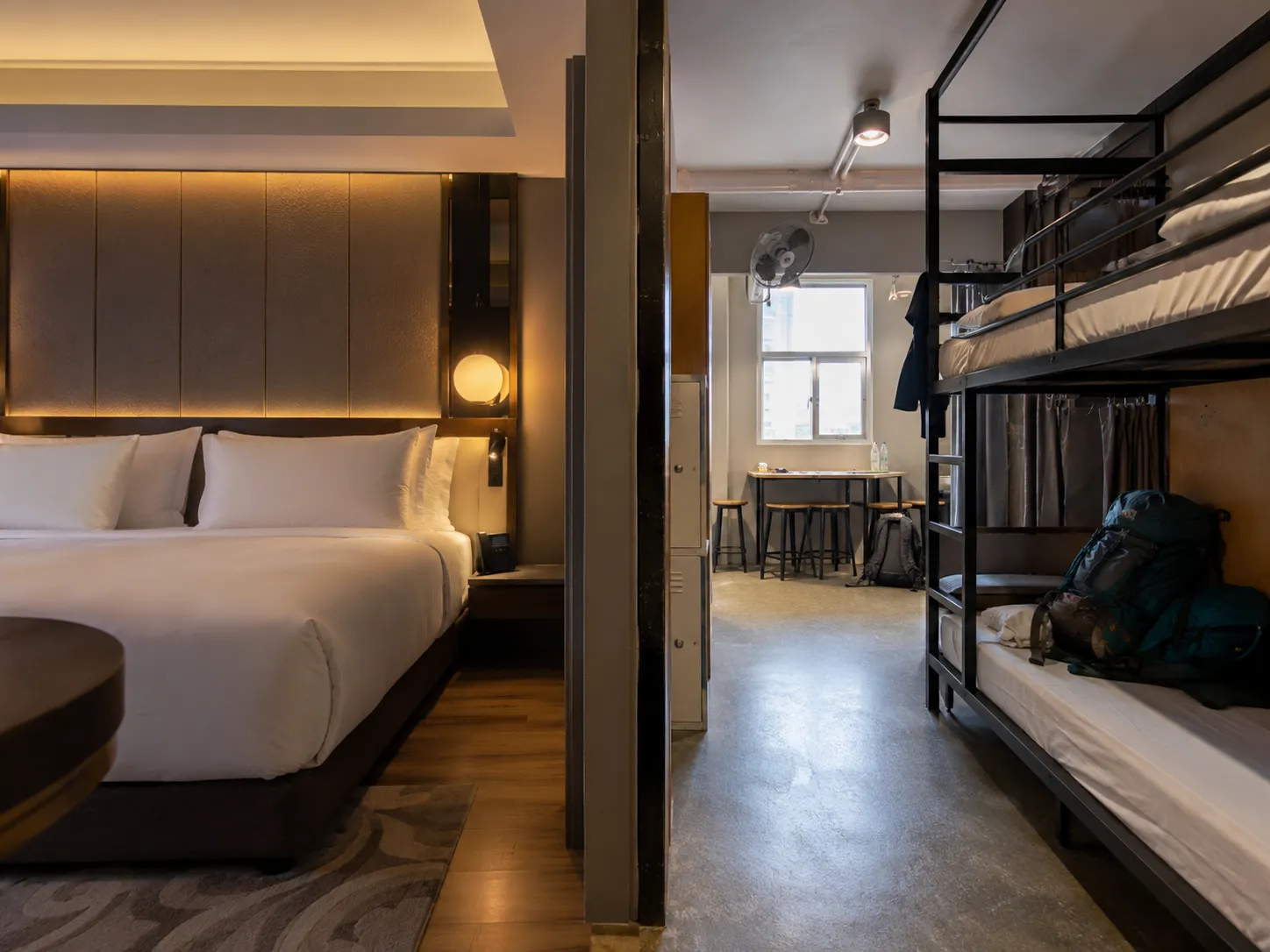
When planning a trip or considering entering the accommodation industry, you will quickly notice that hotels and hostels operate in very different ways. They differ in privacy, service range and the overall approach to guests. One model focuses on predictable comfort and full service, while the other offers a simpler setup, lower prices and a more social atmosphere.
See how these two property types work in practice from both the traveller’s perspective and the point of view of an owner or manager planning to grow an accommodation business.
Hotel vs hostel: the main differences
The main differences between a hotel and a hostel concern price, privacy and the level of service. A hotel provides private rooms, usually with an en-suite bathroom, daily cleaning and a broad range of additional facilities. A hostel follows a simpler model and attracts guests primarily through lower prices by selling individual beds in shared rooms known as dormitories.
The difference is also visible in the predictability of the standard and the general atmosphere. Hotels are subject to official star classifications, which provide a defined service standard, reception support and often access to a restaurant or SPA area. Hostels offer fewer services, but commonly provide a shared kitchen. This helps guests reduce food costs and organise their day independently. Instead of the quiet and formal atmosphere found in many hotels, hostels focus on shared spaces that encourage interaction and make it easier to meet other travellers.
What is a hotel and how does it work from the guest’s perspective?
A hotel is an accommodation property designed to provide comfort, privacy and a largely effortless stay. From the traveller’s perspective, the process is simple: reserve a room, check in at reception, collect a key or access card and use a private space without sharing it with strangers.
The quality of room equipment, service and additional facilities plays a major role in the hotel experience. Common features of a good hotel include:
- Room equipment: a comfortable bed, work desk, wardrobe, television, internet access, minibar or small refrigerator and an en-suite bathroom with towels and toiletries.
- Continuous guest service: a 24-hour reception desk and regular room cleaning included in the stay.
- On-site food and drink: a restaurant serving breakfast, lunch or dinner, often supported by a bar or room service.
- Additional facilities: a wellness and SPA area, swimming pool, gym, conference rooms and event spaces.
- Official standard: a star classification from one to five stars that defines specific quality and equipment requirements.
What is a hostel and who is it suitable for?
A hostel is a budget accommodation property focused on functionality, affordability and informal interaction between guests. Instead of renting an entire room, a guest usually books one bed in a shared dormitory. This is a good option for people who need a safe and clean place to sleep and shower while spending most of their time sightseeing, studying or working outside the property.
Shared areas are at the centre of hostel life. These often include a fully equipped kitchen for self-catering and a lounge where guests can relax and socialise.
The main advantages of hostels include:
- Low price: a significant saving compared with booking a private hotel room.
- Good location: hostels are often situated in city centres, near railway stations, transport hubs and tourist attractions.
- International atmosphere: a suitable environment for meeting travellers from different countries.
- Shared facilities: access to a kitchen, laundry facilities and lockers secured with a key or code.
This model is particularly attractive to students, solo travellers, backpackers and organised groups of friends.
Hotel or hostel: comparing standard, price and privacy
The table below summarises the most important differences and helps determine which type of property is better suited to a particular trip.
| Feature | Hotel | Hostel |
|---|---|---|
| Booking unit | Entire private room | Individual bed or private room |
| Bathroom | Usually private and located inside the room | Often shared and located in a communal area |
| Price | Higher because the guest pays for private space and service | Lower because the guest mainly pays for a place to sleep |
| Food and drink | Restaurant, breakfast and sometimes room service | Usually limited food service, but often a shared kitchen for self-catering |
| Additional facilities and services | SPA, swimming pool, gym, daily cleaning and 24-hour reception | Laundry facilities, lockers and social events |
| Privacy level | High | Low to moderate |
The choice between a hotel and a hostel depends on the purpose of the trip. Business travellers and families planning a longer holiday often choose a hotel because of the quiet environment, workspace and access to full service. For a short city break, a student trip or a one- or two-night stay, a hostel may be a better option because it leaves more of the travel budget available for activities.
Differences from the property owner’s perspective
From an investor’s point of view, hotels and hostels represent two different business models with different start-up costs, pricing strategies and operating requirements.
Opening a hotel usually involves a high entry cost. The property must meet specific building, sanitary and classification requirements and may need a defined minimum number of rooms, depending on local regulations. Revenue comes not only from room sales but also from additional services such as food and drink, wellness facilities and conference space. This creates higher fixed costs because a larger team is required to maintain the service standard.
A hostel generally requires a lower initial investment. It can operate in a converted building or several connected apartments and is not usually subject to the same star-rating model. Its business model focuses on optimising the sale of individual beds while maintaining high guest turnover. Operating costs may be lower because fewer services are offered, but daily work requires precise organisation. For example, staff may need to change the bedding on one specific bed in a room where several other guests are still staying.
Managing bookings in a hotel and a hostel
Inventory distribution and calendar management work differently in the two property types. In a hotel, the main unit of sale is the entire room. A reservation blocks that space for a specific number of guests and may include selected meal plans or accommodation packages.
In a hostel, the process is more dynamic because the basic inventory unit is an individual bed. Selling one bed in an eight-bed dormitory cannot block the remaining seven places. A reservation system must calculate the availability of individual sleeping places continuously while retaining the flexibility to reserve the entire room for an organised group.
Why does a hostel need a good reservation system?
Running a hostel without professional software can quickly lead to booking mistakes and lost revenue. Managing individual beds across several shared rooms while selling through multiple OTA channels such as Booking.com, Airbnb and Agoda creates a constant risk of duplicated reservations.
A modern hostel reservation system supports:
- overbooking prevention: automatic real-time synchronisation of available beds across connected portals;
- dynamic pricing: easy adjustment of bed rates according to the season, day of the week and occupancy;
- group reservation management: fast blocking of full dormitories for groups without disrupting individual sales;
- last-minute booking speed: immediate confirmation for guests booking shortly before arrival.
IdoBooking reservation system for hostels
Are you looking for a tool designed around the way your property actually operates? The IdoBooking reservation system for hostels addresses the challenges faced by accommodation owners and managers every day. Instead of forcing a traditional hotel calendar to fit a hostel model, IdoBooking gives you control over individual reservations and your team’s workflow.
The most important IdoBooking functions for hostels include:
- Bed booking engine: accurate allocation of places in dormitories and control of individual bed availability.
- Real-time Channel Manager: reliable synchronisation with Booking.com, Airbnb, Trivago and other sales channels.
- Booking Engine: direct reservations through the property’s website without intermediary commission.
- Front desk automation: faster check-ins, clear schedules and fewer repetitive tasks for staff.
See how the Multi-Calendar and Channel Manager reduce repetitive manual work for your team. Explore the IdoBooking hostel reservation system and discover how modern technology can automate front desk operations and support the development of a stronger hostel business.
Explore IdoBooking for hostels and see how the system can shorten guest service time, simplify bed and room management and automate everyday processes.
FAQ
Why is a traditional hotel management system often unsuitable for a hostel?
Traditional reservation systems are designed around rooms and apartments treated as indivisible sales units. In a hostel, the main unit is an individual bed. Dedicated software must divide shared rooms into separate places, support female-only, male-only and mixed dormitories and block an entire room automatically when a guest or group books it for exclusive use.
What are the biggest operational challenges in hostel cleaning?
In a hotel, housekeeping usually cleans the entire room after check-out or provides a routine service during the stay. In a hostel, staff may need to change and disinfect only one or two beds in an eight-bed dormitory while other guests are still using the room and storing their belongings there. This requires clear communication between reception and housekeeping and a system that tracks the cleanliness status of individual beds rather than entire rooms.
How can group bookings be managed without blocking individual hostel sales?
Accepting school groups, sports teams and other organised groups requires specific beds or complete dormitories to be assigned immediately and removed from individual sale. Good software allows staff to create a group booking, prepare a combined quotation and update availability across all channels in a few steps. This prevents an individual traveller from booking a bed in the middle of a dormitory already allocated to a group.
How can you avoid overbooking when selling beds on several portals?
With high turnover and spontaneous last-minute reservations, manually updating calendars on different portals is not reliable. The practical solution is a two-way Channel Manager integrated with the reservation system. When a guest books a bed on one platform or directly through the property’s website, the system immediately removes that place from the available inventory across all remaining OTA channels.