
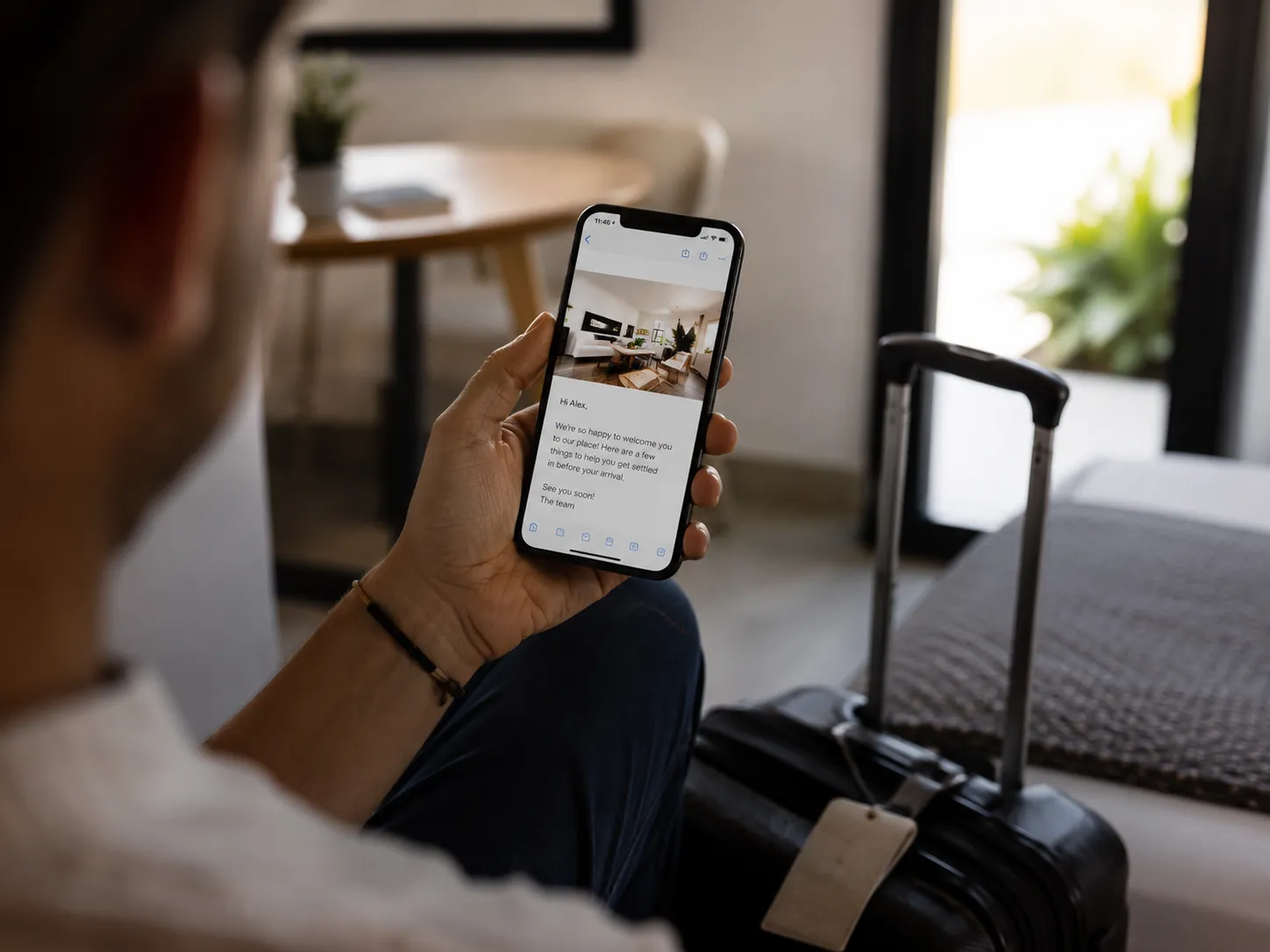
A guest’s first impression is not created when they walk through the hotel entrance or open the apartment door. It begins much earlier, in their email inbox or on a mobile app. A well-prepared pre-arrival welcome message is an important part of a positive guest experience and a professional property image.
Below you will find practical guidance, recommended sending times and ready-to-use message templates for hotels, apartments and self-service properties.
What should a guest welcome message include?
First, it is important to distinguish between two messages that are often confused: a reservation confirmation and a pre-arrival welcome message. The reservation confirmation is sent automatically immediately after the transaction and is mainly formal. It summarises the dates, price and selected services. A welcome message is sent shortly before check-in. Its purpose is to reassure the guest, provide practical information such as directions, parking details or an access code and create a positive sense of anticipation before a holiday or business trip.
An effective welcome message should combine a friendly tone with specific operational information. Guests preparing for a journey do not have time to read a long essay. They need the key details that will help them arrive and check in without difficulty.
A good template should include:
- Personalised greeting: using the guest’s first name or surname creates a more personal relationship and improves the perceived standard of service.
- Key dates and times: the stay dates, check-in time and check-out time.
- Directions and parking information: the exact address, GPS guidance and information about parking reservations or fees.
- Key collection or access code instructions: details of the check-in process, such as reception, a key safe or an electronic lock.
- Payment, deposit or local tax information: a reminder about any payment due on arrival or a link for secure online payments before the stay.
- Emergency contact: a telephone number for reception or the property manager in case of delays or travel problems.
- Additional offer: an opportunity to purchase breakfast, early check-in or a parking space.
When should you send a welcome message before arrival?
Timing has a major impact on whether the message is effective. If it is sent too early, it may disappear among other emails. If it arrives immediately before check-in, the guest may already be travelling and may not read it.
A useful sending schedule looks like this:
| Channel | Sending time | Main purpose |
|---|---|---|
| 1-3 days before arrival | Full information, directions, useful links and additional options | |
| SMS | On the day of arrival, for example in the morning | Short reminder, door code or PIN and contact number |
Hotel welcome letter template
The following template works well for traditional hotels and guesthouses with a staffed reception desk. Because these messages often contain several pieces of information, divide the content into clear sections and use headings or relevant icons where appropriate.
Subject: Your stay at [hotel name] – important information before arrival
Hello [guest name],
Your stay at [hotel name] is coming up soon. We look forward to welcoming you.
To make your arrival as smooth and comfortable as possible, we have prepared some useful information.
📍 Directions and parking:
Our hotel is located at: [hotel address].
The entrance to the hotel car park is on [street name, optionally add a recognisable landmark]. Parking is free / costs [amount] per night.
⏰ Check-in:
Check-in begins at [time, for example 3:00 p.m.]. Our reception is open 24 hours a day / from [opening hours]. If you plan to arrive after [time], please contact us in advance on [telephone number].
🍳 Breakfast and additional services:
Breakfast is served in the ground-floor restaurant from [hours]. Do you have dietary requirements, follow a vegetarian diet or have any allergies? Would you like to add a SPA treatment or another service to your stay? Please contact us before arrival.
We are available if you have any questions.
See you soon,
[signature]
📞 [telephone number] | ✉️ [email address]
Apartment welcome message template
For short-term rentals, clearly explain the practical arrangements and provide precise directions and parking information.
Subject: Your stay at [apartment name] – directions and check-in instructions
Hello [guest name],
We are looking forward to your arrival at [apartment name]. Your stay begins on [date].
Key arrival details:
- Address: [full address, apartment number and floor]
- Check-in time: from [time, for example 3:00 p.m.]
- Key collection: Your keys are in the lockbox next to the door / Keys are handed over in person after prior telephone contact.
🚗 Parking: [information about an allocated underground parking space, the nearest public car park or a resident parking permit]
Fast Wi-Fi, fresh towels and a selection of tea and coffee will be waiting for you in the apartment. Wi-Fi password: [password].
If you have any questions while travelling, call us on [telephone number].
Have a safe journey,
[your name / host]
Short pre-arrival SMS for a guest
A short SMS on the day of arrival can be particularly effective when the guest is already travelling and has limited access to email.
Hello [Name]. We are expecting you today at [Property Name]. Check-in is available from [time]. Address: [street and number]. If you have any questions, call [telephone number]. Have a safe journey.
Welcome message for self check-in and unattended arrival
When a property offers self check-in, accurate and easy-to-follow instructions help prevent unnecessary calls late at night. The following example is suitable for a self-service property using an electronic lock.
Subject: Important: self check-in instructions for [property name]
Hello [guest name],
Thank you for choosing [property name]. Your apartment will soon be ready for your arrival.
Our property offers fully self-service check-in, so you can enter independently at any time after [time].
Entry instructions:
- Main gate or building entrance code: [intercom code]
- Floor and apartment: [floor, apartment number]. A lift is / is not available.
- Electronic lock: enter [door code] and press the confirmation button ✅. The door will unlock automatically.
Wi-Fi network: [network name] | Password: [password]
If you experience any difficulty, contact us on: [telephone number].
We hope you enjoy your stay.
[property name]
This message contains the essential information and allows guests to enter even in the middle of the night without assistance. Do you provide accommodation without reception staff and want to improve access-code generation and cleaning team management? Explore self check-in in IdoBooking, a set of tools designed for modern apartment operations.
The most common mistakes in guest messages
Even a strong template may be ineffective if it contains one of the following common mistakes:
- Too much information
Long lists of rules, restrictions and warnings in the opening paragraph can immediately create a negative tone. Provide the full regulations as a link or attachment and keep a clearly printed copy inside the apartment. - Missing essential arrival details
A lack of precise parking information or an incomplete apartment number is one of the most common reasons for stressed calls from guests waiting outside the building. - Poor mobile readability
Many guests read pre-arrival messages on a smartphone. Long blocks of text without headings, bullet points or sections are difficult to scan. - Sending messages manually at the last minute
Using the wrong guest name, forgetting to send an access code or running out of time to write emails during a busy arrival period can quickly damage the guest experience.
Automatic guest messages in the IdoBooking Communication Centre
Copying and pasting templates, replacing guest names and remembering to send a PIN exactly 24 hours before check-in can take many hours every week. A modern reservation system removes this repetitive work.
The advanced IdoBooking reservation management system can automate guest communication throughout the booking journey. The Communication Centre is particularly important because it gives you full control over contact with each guest.
- Automatic event triggers
Configure the rule once and the system sends the message a specified number of days or hours before arrival. - Dynamic variables
The system automatically inserts the guest’s name, apartment number, stay dates and even an individual access code generated by an electronic lock. - Multichannel communication
Combine email and SMS in one consistent process adapted to guest preferences. Messages from different channels can be assigned to the same guest and reservation, supporting continuity, consistency and better service. - Multiple languages
Create separate templates for international guests. The system selects the appropriate language using the reservation data.
See how communication automation can improve your property’s daily work and reduce repetitive questions from arriving guests. Explore the IdoBooking Communication Centre and automate welcome messages at your property.
FAQ
How much time can automatic guest communication save?
For a business managing several or more than a dozen apartments, manually sending emails and SMS messages, entering access codes and answering the same questions can take several to dozens of hours each month. Automation reduces most of this work because the system performs it in the background while still allowing convenient supervision.
Is an SMS better than an email before arrival?
The two channels complement each other. Send an email one or two days before arrival with the full set of information, including directions, additional options and property rules. An SMS works well on the arrival day as a short reminder of the address or door code when the guest is travelling and may not be checking email.
What are the main benefits of automating welcome messages?
Automation reduces the risk of human error, such as forgetting to send an access code, saves staff time and ensures a repeatable service standard. Guests receive complete and verified information at the right moment, which builds trust in the property before check-in.