
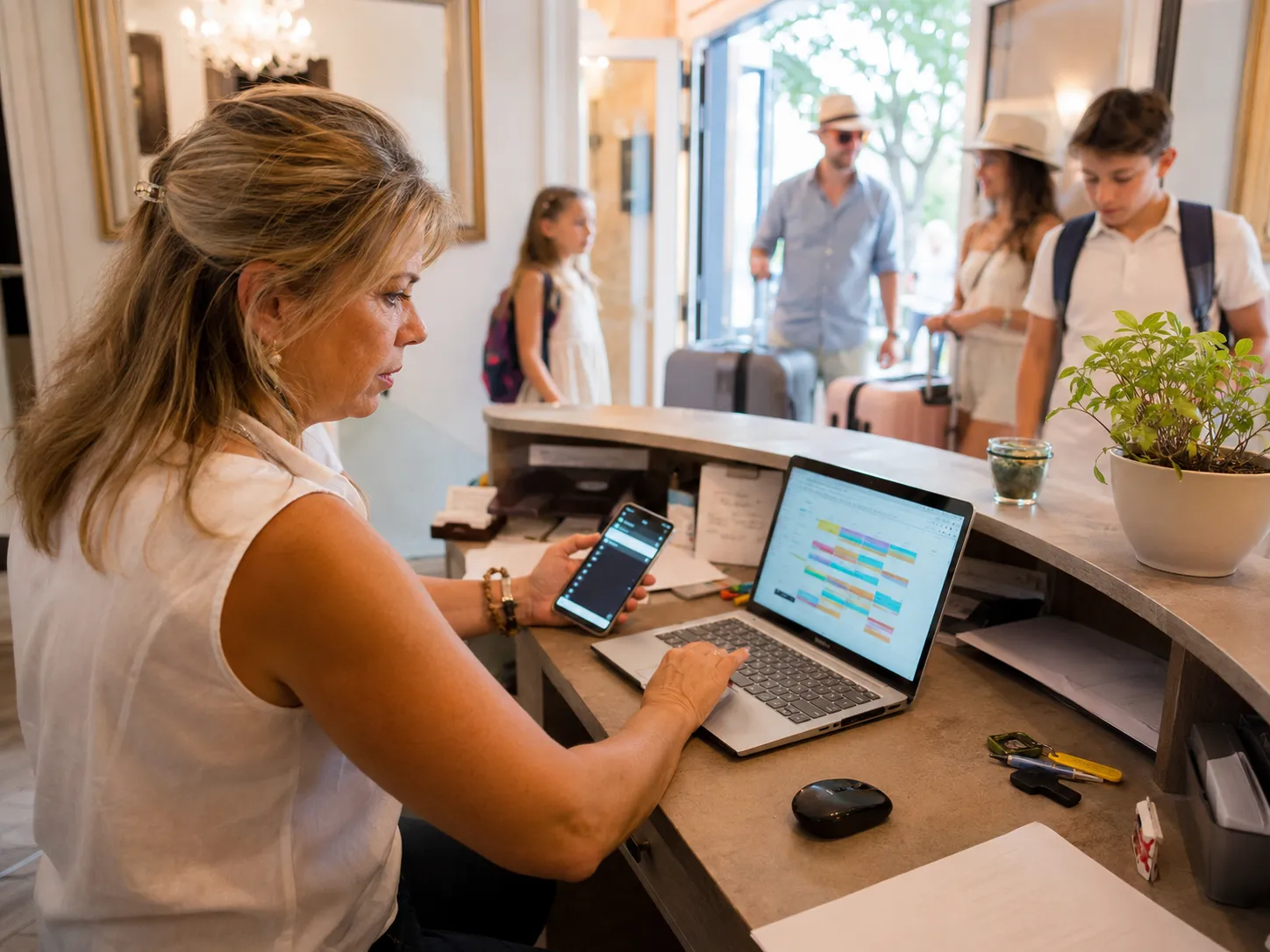
High season brings the greatest occupancy for guesthouses and B&Bs, but it also creates the greatest organisational pressure. In a single day, the team may need to coordinate new bookings, answer guest questions, update room availability, check payments, plan cleaning and respond to changes in stay dates. The more sales channels a property uses, the greater the risk of mistakes, double bookings and outdated prices.
Many small properties still handle a large part of this work manually. Reservation data is stored in several panels, messages arrive from different sources and staff schedules are prepared separately from the stay calendar. This approach may work with a small number of guests. During high season, however, it wastes time, makes work more difficult to organise and increases the risk of costly errors.
The biggest challenges of managing a guesthouse in high season
Organisational problems are rarely caused by strong demand itself. They usually appear when the same information must be entered repeatedly into different systems or passed manually between team members.
Consider a morning with several check-outs, followed by new OTA reservations before noon, another guest calling to ask about a stay and someone requesting a date change or early check-in. At the same time, rooms need to be prepared, payments must be checked and cleaning staff need to receive an updated order of work.
If every process operates separately, the owner spends more and more time on administration instead of managing the property. The most common problems include:
- overbooking caused by unsynchronised sales channels,
- manual room availability updates,
- inconsistent prices across booking services,
- guest communication spread across different platforms,
- difficulties planning staff workloads,
- no current information about room preparation status.
How can you organise reservations from different channels?
Most guesthouses use several booking sources at the same time. In addition to their own website, these usually include Booking.com, Airbnb, telephone reservations and email enquiries. Each channel increases the chance of selling a stay, but also requires constant control of availability.
Manual calendar management creates the greatest difficulty. Every new reservation requires availability to be updated everywhere, while every cancellation or date change means entering the information again. During periods of high occupancy, even a short delay can result in the same room being sold to two different guests.
Centralising all bookings is therefore the basis of efficient management. With a guesthouse and B&B reservation system such as IdoBooking, the owner receives one panel containing reservations from every sales channel. When connected to Channel Manager, availability changes are synchronised automatically. This reduces the risk of overbooking and removes the need to copy data manually between individual services.
The availability calendar as the operational centre of a guesthouse
The reservation calendar is the tool around which the work of the entire property is organised. It helps monitor guest arrivals and departures, block dates for technical work, plan cleaning and react quickly to changes in the stay schedule.
All reservations are visible in one place, regardless of the channel they came from. The owner no longer needs to switch between several panels and can immediately assess the property’s actual occupancy.
If a guest shortens or cancels a stay, the available dates can be released again across all sales channels immediately. The same solution makes it easier to plan longer stays, block selected rooms for maintenance and control availability in real time. With the Multi-Calendar, information remains current and reservation management becomes easier even during the busiest periods.
Guest communication before arrival and during the stay
During high season, guesthouse owners answer dozens of similar questions. Guests want to know when they can check in, whether parking is available, how keys are collected, whether breakfast can be ordered and which additional attractions are available. They may also request changes to invoice details, extensions of their stay or earlier check-in.
Communication is one of the most important factors in building positive reviews, but replying manually to every message can quickly take up a large part of the working day. The problem becomes even greater when messages arrive simultaneously through email, Booking.com, Airbnb and other sales channels. Moving between different panels increases the chance of missing important information or replying too late.
Automatic messages containing directions, check-in times, parking details and house rules can reduce the number of repetitive questions. The owner can still communicate individually whenever additional arrangements are required.
Keeping the complete guest communication history in one place is another major advantage. With the Communication Centre, every message is assigned to the relevant reservation regardless of its source. This makes previous arrangements easy to find, supports ready-made message templates and improves cooperation with employees responsible for guest service.
Prices, packages and seasonal offers in a guesthouse
Pricing policy directly affects a property’s profitability. Keeping one rate throughout the entire season does not always make full use of market potential because demand changes depending on the dates, length of stay, local events and the number of rooms still available.
Guesthouse owners often prepare several offer variants. Prices may be different during public holiday weekends, weekdays and stays covering several nights. Breakfast packages, family offers, additional attractions and wellness services are also popular. Managing this range becomes difficult when every change must be entered separately in each sales channel.
Automation allows the owner to respond much faster to occupancy and market changes. By using Dynamic Pricing, a property can maintain a consistent pricing policy while reducing manual updates. Integration with the reservation system ensures that new rates are published in the appropriate sales channels.
Cleaning, payments and everyday task management
Efficient guesthouse operations involve much more than accepting reservations. Every stay also requires the room to be prepared for the next guests, payments to be monitored and the work of employees responsible for the property to be coordinated.
The greatest difficulties often occur between one guest’s check-out and the next guest’s arrival. If the cleaning schedule is managed separately from the reservation calendar, a changed departure time or an additional booking can easily be missed. As a result, the room may not be ready on time even though the cleaning work itself was planned correctly.
More owners are therefore moving away from paper task lists and telephone instructions. The functional Cleaning Module automatically creates tasks based on current reservations, assigns them to the right people and allows their progress to be monitored. This helps organise the team’s work, reduce misunderstandings and prepare rooms for new guests more quickly. At the same time, the owner has a full overview of task progress and can coordinate other operational responsibilities more easily.
Guesthouse management software: when should you introduce it?
Many guesthouse owners postpone implementing a system until the first organisational problems appear. These are usually double bookings, difficulties controlling room availability, a growing number of guest phone calls or the need to update prices manually across several services. In practice, the tool is introduced only when daily work already requires much more time and attention.
It is more beneficial to analyse the property’s processes earlier. If the owner uses several sales channels, regularly accepts telephone bookings, employs cleaning staff or wants to develop direct sales, organising these processes can quickly improve everyday operations.
Before selecting a specific solution, consider not only the number of available functions but, above all, how they work together. The system should allow reservations, prices, guest communication, payments and daily task organisation to be managed from one panel.
IdoBooking reservation system for guesthouses and B&Bs
Effective guesthouse management during high season does not mean completing more tasks. It means reducing the number of tasks that can be automated. The less time the owner spends copying reservations, updating calendars and answering repetitive questions, the more attention can be devoted to guests and business development.
IdoBooking provides the functions required for daily guesthouse management, from reservation handling and sales channel synchronisation to room availability, guest communication, cleaning organisation and pricing. The owner does not need to use several independent tools or enter the same data multiple times.
Explore the reservation system for guesthouses and B&Bs and see how it can improve your property’s operations. Book an IdoBooking demo today to learn more about its capabilities.
FAQ
Does a small guesthouse also need a reservation system?
Yes. Even a property with only a few rooms may use several sales channels and handle more than a dozen reservations each week. Centralised data makes work easier to organise and reduces the risk of errors.
How can you reduce the risk of double bookings?
The most effective solution is automatic availability synchronisation across all sales channels. Every new reservation then updates room availability immediately.
Can messages to guests be sent automatically?
Yes. Modern systems allow automatic messages to be prepared for reservation confirmations, check-in instructions, information about the stay and reminders sent before arrival.