
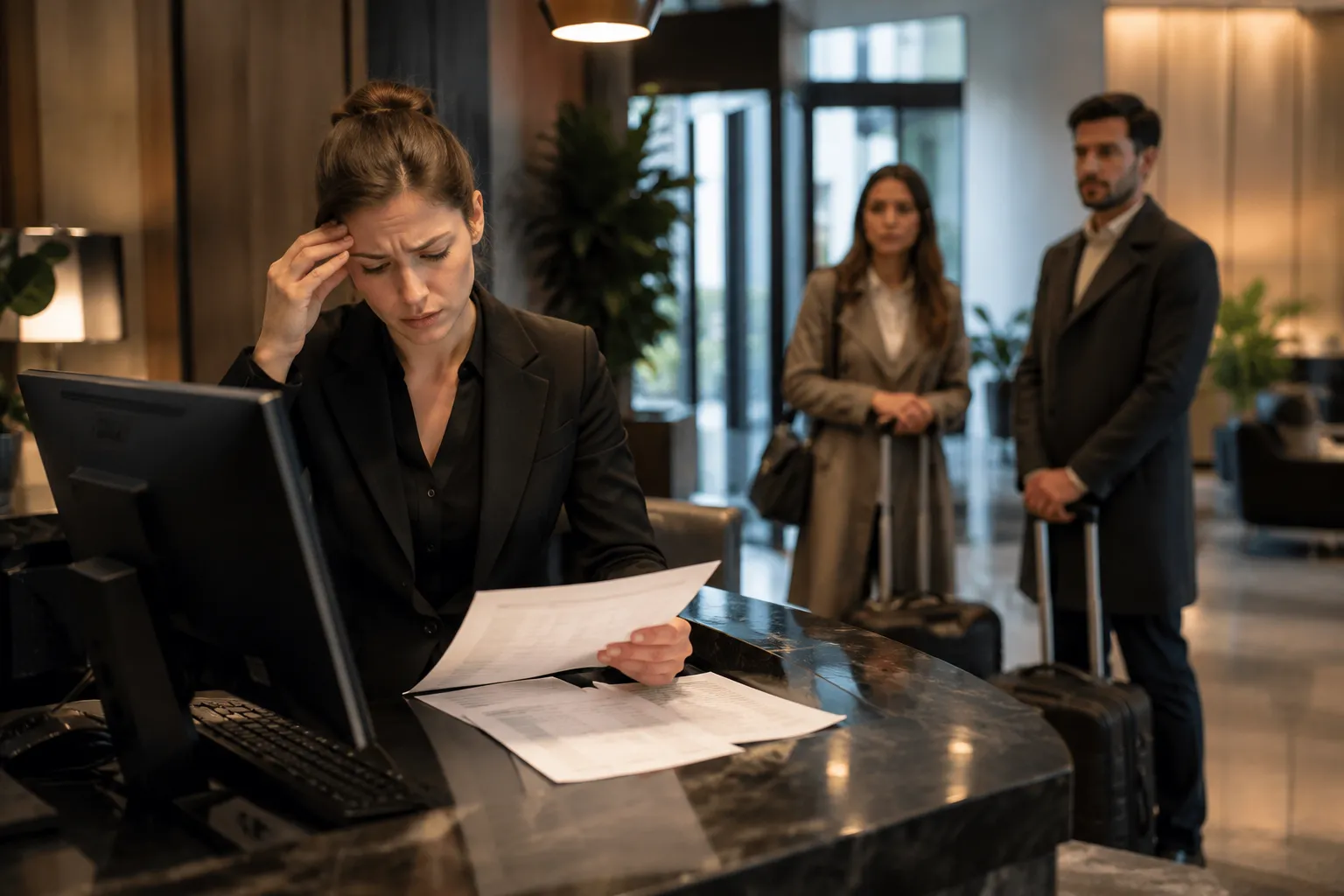
Selling accommodation through multiple channels can increase the number of bookings and help a property reach more guests. At the same time, it makes room availability more difficult to control. If a new reservation is not immediately reflected across every sales channel, the same dates may be sold twice.
Overbooking is one of the most common problems associated with multichannel sales. It creates additional costs, disrupts front desk operations and negatively affects the guest experience. However, the risk can be significantly reduced through well-organised processes and tools that automatically synchronise availability.
What is hotel overbooking?
Overbooking occurs when the same room or apartment is reserved by two different guests for the same dates. Both reservations are confirmed, but the property has only one available unit. The issue is often discovered shortly before arrival or during check-in, when it becomes clear that not every confirmed booking can be fulfilled.
Although overbooking is often associated with large hotels, in guesthouses, apartments and smaller accommodation businesses it is usually caused by organisational errors or a lack of availability synchronisation between sales channels.
The greatest risk appears when bookings arrive from several sources at the same time. If the owner updates availability manually in each portal, even a delay of a few minutes can result in the same room being sold to two people. The risk increases during peak season, when new reservations arrive more frequently and every change requires an immediate calendar update.
The most common causes of overbooking in accommodation properties
Double bookings are rarely caused by one isolated mistake. They usually result from several overlapping factors that create discrepancies in room availability.
Manual reservation management remains the biggest problem. If a property sells stays simultaneously through Booking.com, Airbnb, its own website and other portals, every new booking requires all other calendars to be updated. During periods of high occupancy, it is easy to overlook a change or postpone entering it until later.
Delays in data synchronisation are another frequent cause. A guest books through one service, but the occupied dates are not immediately removed from the remaining sales channels. During that short period, another person may reserve the same room.
Overbooking may also be caused by incorrectly processed cancellations, changes to stay dates or telephone bookings that were not entered into the system immediately. A single outdated availability record is enough for the calendar to stop reflecting the actual situation.
This risk can be significantly reduced with the IdoBooking Channel Manager, which automatically synchronises availability, prices and reservations across all connected sales channels, including through the Booking.com integration. The property owner manages the offer from one place, while information about new bookings is transferred automatically without the need to log in to every portal manually.
What should you do when overbooking occurs?
A quick response is essential. The sooner the owner or a front desk employee identifies the double booking, the greater the chance of resolving the problem before the guest arrives.
The first step should be to determine the cause. Check the reservation history, verify availability across all sales channels and make sure the issue was not caused by an incorrectly entered booking, an unsynchronised cancellation or a delayed calendar update.
If the overbooking is confirmed, contact the guest as soon as possible. Informing them early provides more time to find a solution and helps avoid an unpleasant conversation at check-in. If relocation is necessary, the alternative property should offer a comparable or higher standard. The original property should also cover any price difference and other costs resulting from the situation.
Once the immediate problem has been resolved, analyse the entire reservation management process. If similar situations occur repeatedly, the current workflow needs improvement. A properly implemented reservation management system can organise processes and reduce the risk of similar mistakes.
How does overbooking affect guest reviews and front desk operations?
The consequences of overbooking go far beyond the lack of an available room. It disrupts front desk operations, generates additional costs and may damage the property’s reputation. In the hospitality industry, where many guests make decisions based on online reviews, one mistake can lead to the loss of future bookings.
The front desk feels the impact most directly. Instead of handling current check-ins and answering guest questions, employees have to explain the problem, contact other properties and arrange alternative accommodation. During peak season, when arrivals are at their highest, this can disrupt the work of the entire team.
The consequences also affect the property owner. In addition to relocation or compensation costs, there is a risk of losing the guest’s trust. Someone who does not receive the room they booked is less likely to return and much more likely to leave a negative review on a booking platform. A strong reputation takes a long time to build, while one poorly handled incident can significantly affect a property’s rating.
Why does manual calendar management increase the risk of errors?
As the number of bookings grows, manually updating availability becomes increasingly difficult. Reservations arrive through different sales channels, guests change their stay dates, cancellations occur and telephone bookings are added. Every change must be reflected in the calendar immediately.
Switching between several administration panels increases the risk of mistakes. Missing one update or changing availability in only some channels is enough for the data to become inconsistent. The more portals a property uses, the harder it becomes to maintain full control over sales.
A much more convenient solution is to use one place where all reservations are visible. The Multi-Calendar enables ongoing monitoring of room availability, date changes and blocks regardless of the booking source. This allows the owner and front desk team to work with the same data, making occupancy planning easier and reducing the risk of errors.
Calendar synchronisation as the basis of availability control
The most effective way to reduce the risk of overbooking is to synchronise availability automatically. Every new booking, cancellation or date change is immediately reflected across all connected sales channels. The owner no longer needs to update several calendars manually, while the data remains consistent regardless of where the guest made the reservation.
A Booking.com reservation is a good example. Once it is confirmed, the dates are automatically blocked in all other connected sales channels. The room is no longer available on the property’s website or on other portals, which prevents it from being sold again.
These capabilities are provided by integrations with booking portals. Availability is managed from one place and every change is automatically sent to connected systems. This allows the owner to focus on guest service instead of manually updating calendars.
Channel Manager and Multi-Calendar in overbooking prevention
Automatic data synchronisation is only one part of effective reservation management. It is equally important to keep all information in one place without constantly switching between different administration panels.
Channel Manager synchronises prices, availability and reservations between sales portals. When a guest books a room through one service, the system automatically updates availability in all remaining channels. This removes the need for manual changes and significantly reduces the risk of selling the same room to two people.
The solution is complemented by the Multi-Calendar, which displays all reservations in one view. The owner and front desk staff can quickly check occupancy, plan arrivals and departures and verify room availability without logging in to several systems. This workflow makes daily organisation easier and allows the team to respond to changes more quickly.
Combining both tools creates a more structured sales management process and significantly reduces the risk of mistakes caused by manual reservation handling.
How can you introduce a procedure that reduces double-booking risk?
Reducing the risk of overbooking does not require complex procedures, but it does require consistent use of a few rules. First, every reservation should be entered into one system, whether it was made through a booking portal, the property’s website or by phone. This ensures that the entire team works with the same data.
It is also useful to establish clear procedures for cancellations, changes to stay dates and manually added reservations. Every change should be entered into the system immediately so that room availability always reflects the actual situation.
Regular checks of integration performance and employee training are also good practices. Even the best-configured system will not deliver the expected results if some changes continue to be managed outside it.
If a property sells accommodation through several channels, it is worth exploring the capabilities of IdoBooking Channel Manager and Multi-Calendar. Automatic availability synchronisation and centralised reservation management help organise daily work, reduce errors and make multichannel sales safer.
Would you like to reduce the risk of overbooking and manage reservations from one place? Explore IdoBooking Channel Manager and see how automatic synchronisation of availability, prices and reservations can improve accommodation sales across multiple channels.
FAQ
Is overbooking always caused by the property owner’s mistake?
No. In large hotel chains, overbooking may be part of a deliberate sales strategy. In smaller properties, however, it is usually caused by manual availability management, a lack of calendar synchronisation or organisational errors.
Does automatic synchronisation completely eliminate the risk of overbooking?
Automatic synchronisation significantly reduces the risk of double bookings because every sales channel uses the same current data. Proper system configuration and consistent internal procedures remain essential.
Does synchronisation work only with Booking.com?
No. The system can work with many booking portals at the same time. This allows the owner to manage availability and prices from one place without manually updating every service.
Does a small guesthouse also need a Channel Manager?
If a property sells stays through several channels, automatic synchronisation can make daily work much easier. It reduces the number of manual tasks and lowers the risk of errors that lead to overbooking.